

Infor EPM
Infor Enterprise Performance Management (EPM) is a comprehensive financial performance management platform that integrates financial and operational data across the organization to provide real-time insights, planning, and analysis.
With the foundational technology of Infor OS included with the system, Infor EPM can fully integrate Business Intelligence (BI), budgeting and financial planning, and enterprise performance management into a single solution, enabling organizations to make faster, data-driven decisions.
Key features of Infor EPM
- Integrated Business Intelligence (BI)
- Displays real-time dashboards , KPIs , and data analytics that are directly connected to various transactional systems such as Infor SunSystems, Infor CloudSuite , and ERP, HR, production systems, and others.
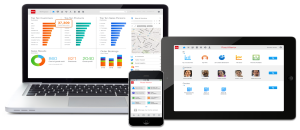
- Interactive dashboards and powerful data visualization tools allow users to easily examine data and identify trends.
- Financial Planning, Budgeting, and Forecasting
- Provides a centralized platform for financial budgeting, forecasting, and modeling.
- Supports both top-down and bottom-up planning approaches, along with scenario analysis and driver -based forecasting.
- Provide support for rolling forecasting and multidimensional modeling to align with financial plans and operations.
- Consolidation and Close Management
- Implement an automated process for consolidating financial statements across multiple companies, currencies, and chart of accounting formats.
- Supports accounting standards including GAAP, IFRS , and enterprise reporting standards.
- Reduce the time required for closing monthly and annual financial statements.
- Performance Dashboards and KPIs
- Display ready-made performance dashboards for finance, operations, and management, anytime, anywhere, when needed.
- Users can track KPIs, deviations, and trends through real-time visualization tools.
- It helps to immediately identify performance gaps and opportunities for improvement.
- Advanced Analytics and Reporting
- Integrating both financial and non-financial data for in-depth analysis.
- Supports ad hoc browsing , drilldown , and dynamic report generation.
- Scenario and What-If Analysis
- It allows users to test various business scenarios with business-specific drivers to analyze their potential impact on profit, cash flow, and operational performance.
- Strengthening capabilities in strategic planning and risk management.
- Integration with Infor Ecosystem
- Seamless integration with Infor ‘s ERP systems ( e.g., SunSystems, M3, LN) and solutions from other vendors.
- Leverage Infor OS for data integration across multiple systems, workflow automation, and Single Sign-on.
- Cloud-Enabled and Secure
- Supports both cloud and on-premise deployments .
- The cloud version delivers scalability , automatic updates, and enhanced security through the Infor CloudSuite infrastructure.
Infor EPM Modules
Infor EPM: Budgeting and Planning System
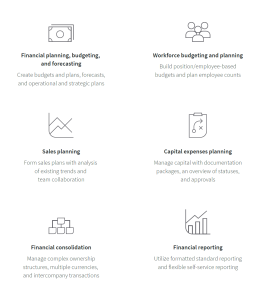
With budgeting capabilities , organizations can collect budget figures through a web-based system or integrated spreadsheets, instead of manually compiling and merging individual spreadsheets. This accelerates the data collection process and reduces the need for re-entering data or fixing broken spreadsheet links, which often lead to errors and version control issues.
Once approved, budget information, along with explanations or supporting details, will be recorded in a secure PM database, ensuring that all parties within the organization can use the same set of data consistently.
EPM also comes with ready-to-use financial and budgeting functions, such as automatic roll-ups, various calculations , multi-currency support and conversion , multi – company budgeting , and planning for both profit and loss ( P&L) and balance sheets.
Because EPM stores all data in a central database , users can compare budget figures with actual performance and forecasts side-by-side and on demand, without having to open multiple applications.
The benefits of a planning and budgeting system.
- Reduce the time spent on data collection and budgeting.
- Resolve file version control issues.
- Automated data integration, including calculations and currency conversions, reduces errors and saves time.
- Track budget submissions and actual performance results.
- Plan salaries and assets at a detailed level for budget accuracy.
- Set up automatic notifications to alert you when unexpected events occur, so you can take immediate action.
- Adjust budgets and communicate changes as business conditions evolve, maintaining organizational alignment and commitment.
- Use the results to set realistic performance targets for employees, management, shareholders, and stakeholders.
Infor EPM: Financial Statement Consolidation System
The web and cloud-based Infor EPM enables organizations to quickly consolidate data from operations worldwide, even if each location uses a different General Ledger ( GL), chart of accounts, or ERP system . Data is aggregated according to national and international standards such as GAAP, Sarbanes-Oxley , and IFRS and stored in a single database, allowing everyone to access the same dataset via an Excel or web interface.
Any data corrections occur at a single central point, providing greater control and confidence in the figures. The data can be compared against budgets, plans, and forecasts within the EPM , enhancing understanding of business performance management.
With its comprehensive journaling and auditing functions , EPM provides financial reporting transparency to meet the needs of both internal and external auditors .
Benefits of a consolidated financial statement system.
- Comply with national and international accounting standards and reporting requirements such as GAAP, FASB, IAS, IFRS , and Sarbanes-Oxley.
- Enhance process control with centralized data storage and management.
- Accelerate the financial statement consolidation and reporting process with automated data retrieval across key processes such as data loading, statement consolidation, and auditing.
- Collect, process, report, and analyze data in multiple currencies, including reports on the impact of currency fluctuations.
- Implement automated adjustments such as minority shareholder equity, intercompany transaction elimination, rework, cost allocation, and other adjustments.
- The data is compiled from multiple business perspectives (region, product line, etc.) and various structures (current year/month compared to the previous year/month, etc.).
- Transform data into actionable insights by comparing results to budgets and forecasts.